
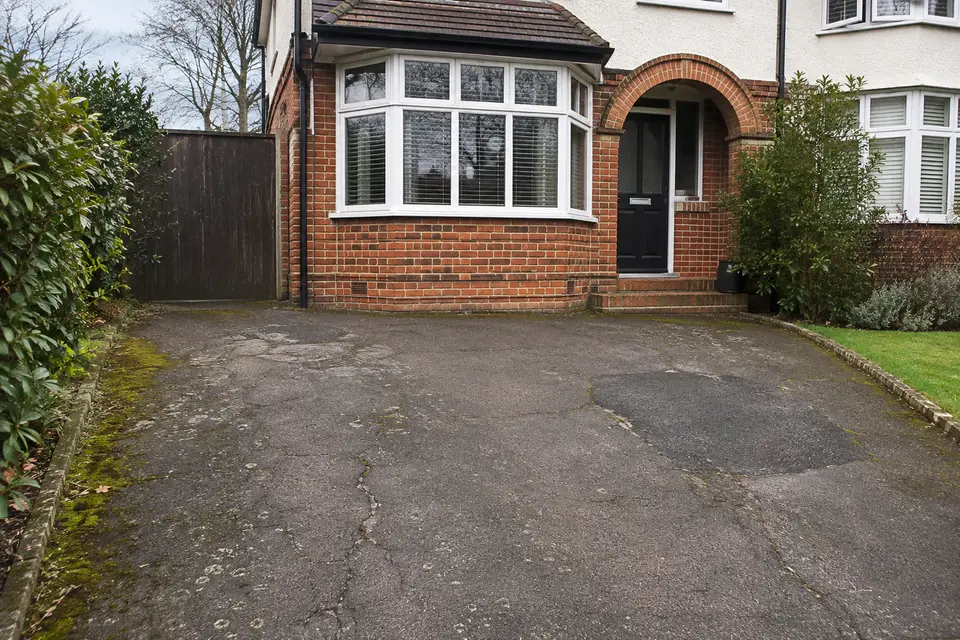
Probably the question I get asked most when I'm out measuring up, and fair enough. Digging out an old drive is a big chunk of the cost, so if the resin can go straight on top, why wouldn't you? Sometimes it can. This is how I decide.
Tarmac
Sound tarmac makes a decent base for resin. Sound is the word that matters. It needs to be firm, not crumbling or rutted, with no soft spots that give under your foot and no weeds pushing up through it. Weeds coming through usually means it's breaking up underneath.
I'll also look at where the water goes. If your tarmac drive puddles now, putting resin on top doesn't fix that. It just hides it for a bit.
Concrete
Concrete can work too, with one big catch: the joints and the cracks. Concrete drives go down in bays with joints between them, so they can move a little. The resin on top can't move the same way, so those lines have a habit of coming straight back through as cracks.
There are ways of dealing with joints. But on an old drive that's already full of cracks, you're usually better off digging out and starting again than paying for a lovely new surface that cracks along the old lines.
Block paving: I won't
I won't put resin over block paving, full stop. Every block moves a fraction under the car, the sand in the joints shifts about, and a thin layer of resin on top can't cope with that for long. You end up with a cracked grid that follows the blocks underneath. If you've got block and want resin, the blocks come up first.
Will it still let water through?
This one catches people out. Resin bound lets water through, but if it's sitting on solid tarmac or concrete, the water just reaches the old surface and runs off from there. So as far as drainage goes, an overlay behaves the same as the drive it's covering.
Out the front that matters for planning. If your drive runs off onto the road now, we'll talk about drainage before anything else.
Height and edges
An overlay adds height. So I check where the new surface will finish against the damp-proof course on the house, the front door and garage thresholds, and where the drive meets the pavement. Sometimes the edges need cutting back, or a new edging course, so it finishes neatly instead of leaving a lip for someone to catch their toe on.
What I'll tell you
When I come out I'll walk the drive, look at the cracks, check the falls, and tell you straight whether it's an overlay job or a dig-out. If it's borderline, I'll say so, and tell you what I'd be worried about.
Related services