
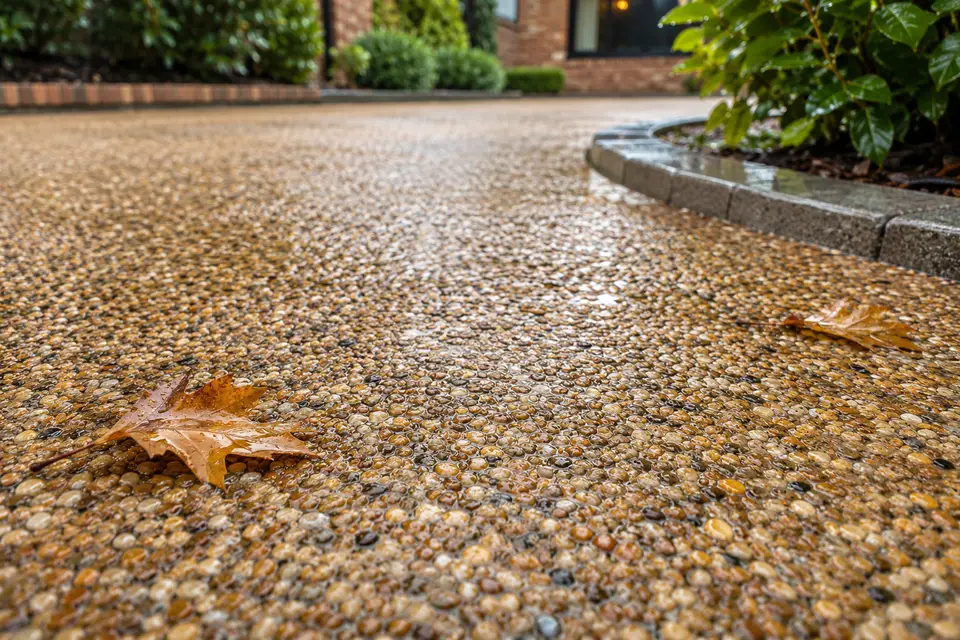
Laid properly on the right base, a resin bound drive should go well past the ten-year guarantee we put on ours. The ones you see breaking up after two or three winters nearly always went wrong in the same few places, and it's very rarely the resin's fault.
What actually decides it
Three things, roughly in the order I see them go wrong: the base underneath, the mix, and the weather on the day it went down. Get those right and the surface itself is tough stuff. It's stone locked in resin. It doesn't care much about rain, frost or the bin lorry reversing into your entrance.
The base
Most early failures are really base failures. Resin's a thin wearing layer, so it takes on whatever it's laid over. If the old concrete's got a crack across it, give it a year and that crack will be in your new drive as well. If the tarmac underneath is soft or breaking up at the edges, the resin goes with it.
A proper job either digs out and builds a new porous base, or gets down and looks hard at the old one before agreeing to go over it. If someone quotes you an overlay without doing that, ask them what they're going to do about the cracks. Then watch their face.
The mix, and how thick it goes down
Resin bound is mixed on site, a measured bag of dried stone to a kit of resin, then trowelled out by hand. Skimp on the resin to save a few quid and the stones start coming loose, usually first where the car turns. Lay it too thin and it won't take the weight. The manufacturers publish a minimum depth for driveways, and it's a perfectly fair thing to ask about before you sign anything.
UV-stable resin, or not
There are two kinds of resin. The cheaper aromatic sort darkens in the sun, so a lovely light golden drive can turn a dull brown within a couple of years, worst on the sunny side. UV-stable resin keeps its colour. It costs more, and it's worth it. It's the only kind we use.
The weather on the day
Resin hates being laid in the wet or the cold. A damp base or damp stone stops it curing properly, and that shows up later as a weak, crumbly patch. If it's raining or getting close to freezing, a decent installer moves the job. It's a pain when you've booked the day off, I know. It's a lot less of a pain than a patch that fails.
Signs it was laid badly
Loose stones gathering along the edges after the first few months. Patches darker or duller than the rest. Fine cracks that line up with something underneath, like an old joint in the concrete. Puddles, which on a permeable drive mean the base below isn't draining. See any of that in the first year or two, and ring whoever laid it.
Looking after it
There's not a lot to it. Give it a sweep, and a wash with the hose or a pressure washer on a low setting a couple of times a year, so leaves and grit don't clog the gaps between the stones. Get oil drips up while they're fresh. In the snow, use a plastic shovel, not a metal one.
Related services