
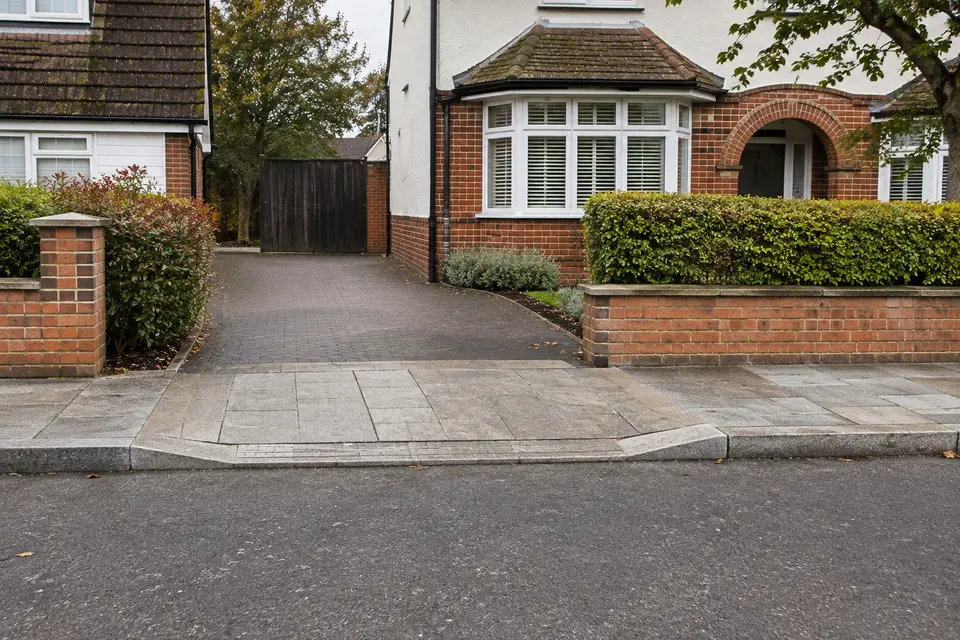
If you're putting a new drive in at the front and you'll be driving over the pavement to get onto it, you need a dropped kerb. And no, you can't just get the driveway lads to knock one in while they're there. The pavement belongs to the highway authority, so it's their permission, and in some areas their contractor. This is how it works round here.
Who to apply to
Bournemouth, Christchurch and Poole: BCP Council. The rest of Dorset: Dorset Council. Hampshire: Hampshire County Council, because they look after the roads, except in Southampton and Portsmouth, which run their own.
What it costs
The kerb is a separate bill from the drive. BCP and Dorset Council both give a guide figure of around £2,000 for a typical crossing. BCP's is for a standard crossover of three dropped kerbs plus the sloping ones either side. Dorset's is for a typical five-metre crossing on a 1.8-metre pavement.
Every job gets priced on its own, and it goes up if a lamp post, a road sign or a utility cover has to be moved, because you pay for that as well.
Who does the work
Depends on the council. Dorset Council says it has to be done either by them or by a contractor who's authorised to work on the highway. Hampshire lets you pick your own contractor once the council's agreed your application, as long as they meet the council's requirements, proper insurance included. BCP prices the job for you as part of the application.
Wherever you are, the crossing has to be built to the council's spec, which is deeper and stronger than a normal footpath. It's not just a footpath with a ramp in it.
Sort these out before you apply
Check your deeds say you can park on your property. If you rent, you'll want your landlord's permission in writing. And get the tape measure out on your front garden: councils want room to park a car fully off the pavement. If the back end would hang over it, expect a no.
Also check whether you're on a classified road, an A, B or C road, because then you might need planning permission as well.
Why they get turned down
Usually not enough room to park clear of the pavement, a spot too close to a junction, a crossing or a bus stop, a street tree in the way, or a pavement that can't be levelled safely for a car to cross. BCP also lists listed buildings among its reasons.
Leave yourself time
Applications take weeks, not days. BCP's quotes are good for six months from when they're agreed, and Hampshire wants the work done within twelve months. My advice: get the kerb application in as soon as you know you want a drive, then plan the drive around when the crossing can go in.
Related services